I see a lot of parallels between the work kids do in Math in Your Feet and the Maker Movement. Not only is the human body our original “technology” and the tool with which we learn about the world and develop our cognition from birth, but the “maker” philosophy aligns with my own approach to bringing math and dance together in elementary classrooms.
Mitch Resnick is the LEGO Papert Professor of Learning Research and head of the Lifelong Kindergarten group at the MIT Media Lab. Resnick recently sat down for a conversation with EdSurge. You can read the whole conversation but, below, I’ve focused on his thoughts about the process of making.
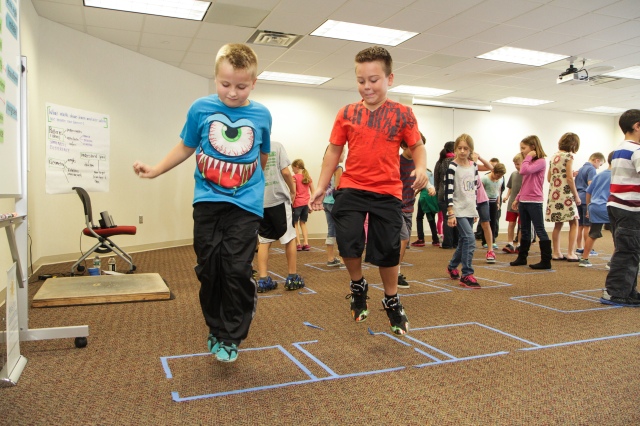
When one comes upon a whole classroom of moving bodies dancing in little blue tape squares it’s easy to to miss the forest for the trees, in the sense that it looks a lot like dance and not a whole lot like math. The reality is that math making and dance making have a lot in common. Both share a process by which the learner experiments, asks questions, revises, reflects and…often….has something tangible (an answer or some choreography) to show for it. Resnick’s comments below resonate with the premise of the new book.
One of the things that appeals to me about the maker movement is that it’s not just about making. That’s an important part of what the maker movement is about. If you give a child a set of step-by-step instructions and build something, in one way, they’ve made something—but that’s not the spirit of the maker movement.
“Spatial thinking is integral to everyday life. People, natural objects, human-made objects, and human-made structures exist somewhere in space, and the interactions of people and things must be understood in terms of locations, distances, directions, shapes, and patterns.” -National Research Council
For an overview about how to help students make – and sustain – gains in their learning and understanding of mathematics check out the short but mighty Paying Attention to Spatial Reasoning from the Ontario Ministry of Education. Resting on a rigorous research base, this publication outlines seven foundational principles for focusing on spatial reasoning in the classroom. It also provides useful examples of what paying attention to spatial reasoning can look like in K-12 math classrooms.
Malke Rosenfeld delights in creating rich environments in which children and their adults can explore, make, play, and talk math based on their own questions and inclinations. Her upcoming book, Math on the Move: Engaging Students in Whole Body Learning, will be published by Heinemann in Fall 2016.
Lots has been written about how and why I brought math and dance together for young learners but it all started here: with the joy, the expression, the sounds, the rhythmic structure of traditional percussive dance.
This is a style of Canadian step dance. Small pieces of movement and rhythm combine to create a gorgeous improvisation. Children can use the elements of percussive dance to create their own gorgeous foot-based, math-based creations.
Malke Rosenfeld delights in creating rich environments in which children and their adults can explore, make, play, and talk math based on their own questions and inclinations. Her upcoming book, Math on the Move: Engaging Students in Whole Body Learning, will be published by Heinemann in Fall 2016.



 Math on the Move