Math off the Page: Relational Understanding & Scale

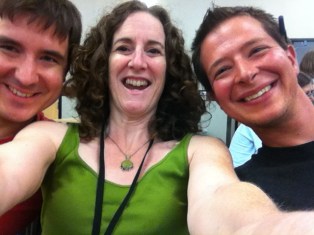
`me-and-the-boysWhen I showed up at my first Twitter Math Camp in 2014 I was a ball of nerves. It was my first chance to meet, in real life, the math teachers of the #MTBoS from whom I had learned so much. I’m probably not the only person who feels nervous at their first in-real-life meeting of online friends or colleagues. What I noticed was that, while I could anticipate certain things about a person from our online interactions, having a chance to interact with them in real time and space enriched and deepened our interactions. By the end of our three days learning together, making math after hours, and chatting over a variety of meal times, I found myself with a much more nuanced understanding of my friends and colleagues.

I think it’s the same kind of situation for math learning. 

Richard Skemp defined the difference between Instrumental and Relational Understanding in math. Here’s a visual overview (via David Wees) of the difference between the two kinds of understanding:

instrumental

Math teacher Mark Chubb explains in his blog post Focusing on Relational Understanding:

Students who are taught instrumentally come to see mathematics as isolated pieces of knowledge. They are expected to remember procedures for each and every concept/skill.  Each new skill requires a new set of procedures.  However, those who are taught relationally make connections between and within concepts and skills.  Those with a relational understanding can learn new concepts easier, retain previous concepts, and are able to deviate from formulas/rules given different problems easier because of the connections they have made.

My perspective on relational understanding focuses getting to know a math idea in multiple contexts. Zoltan Dienes (creator of the base 10 blocks you use in your classroom) thought so too (bolding mine):

According to Dienes … mathematical abstractions occur when students recognize structural similarities shared by several related models. For example, when base-ten blocks are used to teach arithmetic regrouping operations, Dienes claimed that it is not enough for students to work with a single model; they must also investigate “mappings” to other models, such as bundling sticks or an abacus … a primary goal is to help students recognize how patterns of relationships in one model correspond to patterns of relationships in another model.

Because math is frequently presented in a static way, whether in textbooks or on worksheets, the dynamic action represented by those symbols and figures are often lost in the shuffle. The experience of math in this single mode and a series of fixed images, ideas, and answers might leave us to wonder:

How can we  learn math out of our seats? How can we learn math if its not written down? 

As part of my new First Steps series for bringing #movingmath into the classroom in a low-stress way we’re gonna’ have a TON of fun exploring math off the page in the next few months!

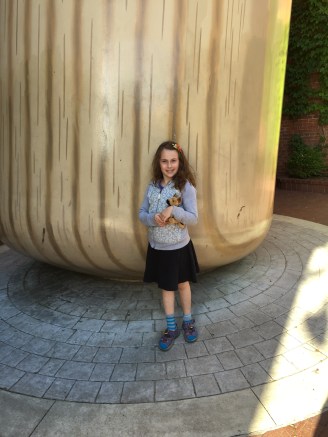
To kick things off let’s start by finding the math idea of scale as it exists off the page. Scale is a ratio that compares the size of one thing to another. It is what we are thinking about when we ask “how much bigger/smaller, taller/shorter, or faster/slower.” For example: In this picture of the Louisville Slugger Museum and Factory, how much bigger is the bat to the building? How much smaller is my kid compared to the giant bat?

bat-and-building  kid-and-big-bat

Another example of scale off the page (which also does double duty as a great example of whole-body #movingmath) are the videos from OK GO, below.  To create the video for the song I Won’t Let You Down the music was slowed down 50% to record the complex movements at half the speed. It clocks in at about 10 minutes. The song and moving images were sped up for the final video which clocks in a little more than 5 minutes .

Overall, it’s not about whether one mode of math thinking and doing is better than another. It’s about providing opportunities for our students to really get to know a math idea in all its forms. We do this when we provide opportunities for learners to reflect on the process by which they arrived at an answer, by recognizing that watching an OK GO video during unit about scale might provide students with new insights, or by creating a lesson where students use their own bodies as measuring tools.

Whole-body math learning is one part of a whole variety of experiences that, taken together, help build a personal relationship to math so that we can recognize and rely on our new friend … on the page … and off.


Malke Rosenfeld is a dance teaching artist, author, editor, math explorer, and presenter whose interests focus on the learning that happens at the intersection of math and the moving body. She delights in creating rich environments in which children and adults can explore, make, play, and talk math based on their own questions and inclinations. Her new book Math on the Move: Engaging Students in Whole Body Learning was recently published by Heinemann (2016). Join Malke and other educators on Facebook as we build a growing community of practice around whole-body math learning.

New Year, New Tools for Making Sense of Math!

happy-hoppy-new-year

Happy 2017!! This year harness the original “thinking tool” to help your learners make sense of math! What is this tool, you ask? Why, your students’ own bodies and creative spirits of course!

Math on the Move: Engaging Students in Whole Body Learning is now available from Heinemann. Included in the book are specific, actionable ideas for including your students’ moving bodies in the math you are already doing in your classroom!

Here is your first tip in the New Year for a simple first step in bringing Math in Your Feet and other #movingmath activities into your classroom in a low key way.  All the best to you for a new year filled with enthusiastic math making!

new-year-new-tools-tip-1

You can download the Movement Variables from the Classroom Materials page.

Interested in having First Steps show up in your inbox in a semi-regular and non-irritating fashion? Join my mailing list! 

Will you tell us about your #movingmath adventures with us? I’d love to hear your stories. Share with us on Twitter or at the book group on Facebook.


Malke Rosenfeld is a dance teaching artist, author, editor, math explorer, and presenter whose interests focus on the learning that happens at the intersection of math and the moving body. She delights in creating rich environments in which children and adults can explore, make, play, and talk math based on their own questions and inclinations. Her new book Math on the Move: Engaging Students in Whole Body Learning was recently published by Heinemann (2016). Join Malke and other educators on Facebook as we build a growing community of practice around whole-body math learning.

A Framework for Whole-Body Math Teaching & Learning

gallery-5

What is whole-body math learning? How can we be doing math if it’s not written down? What are our expectations for student work and learning math out of their seats?

My focus in Math on the Move is on how we can harness our students’ inherent “body knowledge” to help them develop new understanding and facility with mathematical ideas that often seem remote and impenetrable as presented in their textbooks. This is not to say that math is this way, but for many people, myself included, the symbolic side of math creates a barrier, at least initially, to understanding. This is why approaches like Numberless Word Problems  (“They just add all the numbers. It doesn’t matter what the problem says.”) and Notice and Wonder  were created: to help kids make sense of math.

The phrase “body knowledge” was coined by the late Seymour Papert, a protégée of Jean Piaget. In the 1980s Papert’s work at MIT focused on developing “objects to think with,” including the Logo computer programming system for children. Here are a few images of children engaged in self-initiated, body-based exploration of a math idea as they investigate the spatial aspects and physical structure of their environment.

Papert’s intention was to harness a child’s own lived experiences and natural, self-intiated explorations in the world as a way to investigate more formal mathematics via the programming of a little metal object called the “Turtle.” Much of what we do in Math in Your Feet is similar to what children do with the LOGO turtle – working independently or in teams within a specific system/constraint, investigating and creating units of commands or patterns in a spatial and geometric language and, along the way, fine tuning our intentions and results.

Similar to Papert’s work, Math on the Move is about math, but it is also about the nature of learning by actually making something and the need to develop strong pedagogy for what might be seen as a non-traditional approach. For me this means a meaningful  interdisciplinary, movement-based approach beyond the preschool years. In the first chapter I provide an overview of what meaningful whole-body math learning looks like in my own and others’ moving math classrooms. I clarify the body’s role as a thinking tool and its use within a purposeful making and learning context. I also provide a conceptual framework and pedagogical base for any educator wishing to do similar work with his/her own students at body- or moving-scale.

Because our encounters with math have been, for the most part, visual and on the page, a whole-body approach to learning math may feel foreign to both teachers and students. To quell the qualms of others who may want to try this approach in their own classroom I have spent years working to define the pedagogical elements that must be present so children can think deeply and engage in mathematical sense making with their whole bodies.  The criteria (which are explained in more detail in the book) include:

  • The lesson explores one or more mathematical ideas off the page and out of the chair.
  • The math-and-movement lesson provides a structure in which students make choices, converse, collaborate, and reflect verbally on what they did and what they noticed while they were engaged in whole-body-based activity.
  • The body activity is focused on mathematical sense making, and  often through efforts to solve a challenge of some kind, not on using the body to illustrate a math ideas as it is typically represented on the page.
  • The teacher is not the expert but acts as the facilitator of the learners’ activity by setting expectations for controlled, intentional movement, and monitoring lesson pacing and classroom discussion.
  • Students reflect on the activity as both doers and observers, learning from their own experiences and the work and thinking of their peers.
  • In partnership with the change of scale, the math-and-movement activity should be explicitly connected with the same math idea as it is experienced in other contexts, scales, or modes. 

    Just like any organized lesson, moving math needs a frame of expectations and learning goals. It may look and feel different from the norm, especially because its kinetic nature, but as long as there is an underlying structure and intent, it’s worth exploring to see what the possibilities might be.  You might be very surprised at how enthusiastically children embrace the opportunity to harness their whole selves, body and mind for a mathematical investigation!


    Malke Rosenfeld is a dance teaching artist, author, math explorer, and presenter whose interests focus on the learning that happens at the intersection of math and the moving body. She delights in creating rich environments in which children and adults can explore, make, play, and talk math based on their own questions and inclinations. Her new book Math on the Move: Engaging Students in Whole Body Learning was recently published by Heinemann (2016). Join Malke and other educators on Facebook as we build a growing community of practice around whole-body math learning.

Learning without a Body

Lunch time at my daughter’s small school means children are free to move around both inside and outside of the school within boundaries determined by their grade level. Often, lunch time is not just for eating (as evidenced by half-eaten sandwiches in the lunch box at the end of the day).  Lunch is for making up skits, finding interesting properties in the rocks you are pounding, for having arguments and making up, for exploring the narrow (but long) strip of trees that line one side of the school’s property, called ‘the woods’, and for creating clubs.  At a school with a no-exclusion rule, a club can be pretty much any combination of kids at any one time.

One day, when my daughter was in third grade, she told me her club had made a fort in the woods. At first glance it looked rather like a wall.  A very well constructed, sturdy wall, a wall built with a lot of thought and insight. There is a base of bricks and concrete and then a layer of sticks. There was also a latch (a piece of wire) which is lifted by the “door” (a stick), “Although we don’t usually go in this way because it’s not sturdy,” she told me, “we usually just go in over the low wall.”

Hearing about and seeing this fort I immediately thought about the article Ophelia’s Fort by fourth grade teacher and artist David Rufo which I edited for the Teaching Artist Journal’s online writing community ALT/space. In it he writes:

“During our conversations it became evident that Ophelia was focused on making for herself a “special place” rather than a special structure with four walls, a roof, and a door. As David Sobel emphasized in his book Children’s Special Places: Exploring the Role of Forts, Dens, and Bush Houses in Middle Childhood: ‘Through making special places, children are experiencing themselves as shapers and makers of small worlds. This experience contributes to making them active shapers of the world in their adult lives.'”

 In sharing this story about my daughter’s lunchtime adventures, I am aware that it is not about math learning, per se, but it does relate to why I wrote a book about the whole-body math learning. In past writings I have focused very closely in on the specifics of the Math in Your Feet program; the new book was a chance for me to step back and look at the broader issues involved in making math and dance at the same time.

One of the ideas that came into view as I zoomed out during the book writing is the necessity of agency in learning. It is clear that issues of learner agency begin with the body.  And, when thinking about using dance or movement as a partner in learning we must start by identifying how the body has historically been employed during school hours.  That is to say, how the body has not been employed (bolding emphasis mine):

“The embodied experience of traditional schooling is often, as educational philosopher John Dewey might suggest, an anaesthetic experience, devoid of any heightened sensory experience or perception. In school, our bodies are still, serving primarily a utilitarian function.  We learn to from an early age not to squirm or leave our desk chairs in classrooms. We learn to sit up straight, raise our hands to be called upon, or walk single file to lunch.  By the time we reach high school our bodies are often reserved for gym class…or for moving from one class to another. In a sense, we educate from the neck up, leaving the rest of the body to act largely as physical support rather than as actively involved in our quest for knowledge, thinking, and understanding … implicated in this analysis is the importance of agency in relation to activity. Providing curricular opportunities that are experience-based, that encourage the use of the body and engage the senses in learning could create a different kind of [structure] for schooling if learners are encouraged to explore connections between learning, self and the broader social and cultural frameworks of meaning in which they are situated.” 

Source: Powell, K. The apprenticeship of embodied knowledge in a taiko drumming ensemble. In L. Bresler (Ed.), Knowing bodies, moving minds: Embodied knowledge in education (pp. 183-195). Dordrecht, The Netherlands: Klewar Press.

The body is not simply a vehicle toward realizing the perceived pinnacle of abstracted knowledge housed in the mind.  The body is where learning originates. Living in a body is also the way children learn personal agency as they make decisions about how their bodies will move and act and how that power can influence and shape their world. And, in the process, learning that there are obvious consequences and responses in relation to their actions. This is literally and viscerally democracy in action.

Perhaps most importantly, despite the incredible change of pace and screen-focused activity in modern life, children still have brains that learn best by moving and pulling sensory input in through all parts of the body.  Hundreds of years of thoughtful analysis, research, and observation of children learning and growing has shown this to be true and yet the body is still being marginalized in favor of  “knowledge” as something gold and shiny to be won and placed on a high shelf for viewing, far removed from any experience and personal understanding.

What is a body without agency?  What is learning without a body? Thinking about these questions is the important first step in understanding the inherent worth of children using their bodies to make sense of mathematics.

This is slightly altered reposting of the 2013 version of the same title on the authors former blog The Map is Not the Territory.


Malke Rosenfeld is a dance teaching artist, author, and presenter whose interests focus on the learning that happens at the intersection of math and the moving body. She delights in creating rich environments in which children and adults can explore, make, play, and talk math based on their own questions and inclinations. Her new book is titled: Math on the Move: Engaging Students in Whole Body Learning (Heinemann 2016)

“Children think and learn through their bodies”

NOTE: I was thrilled to be invited by Table Talk Math to write a short piece for their weekly newsletter, and they have graciously allowed me to cross post a slightly expanded version here. Check out their resources for supporting math talk at home around the dinner table or any time!


cosmo-heightWhen my daughter was six she was prone to spontaneous bursts of body-based mathematical exploration.  That summer we had two flower plants in our garden that she had nurtured from seed.  By mid-August they had refused to blossom but were still gaining height and had become a daily source of measurement.  She’d compare the plant to her own height, “The cosmo is taller than me!”  As we turned toward autumn she was ecstatic to pronounce, “It’s up to Papa’s chin now!”
That same summer we read the book Sir Circumference the first Round Table a number of times.  She developed a game where she would leap  toward her blow-up wading pool in what she called the “diameter jump.” I held my breath every time as she leaped, finger tips to toes stretched out in one long line to touch the front and back of the pool at the same time, literally flying, flopping almost on the other side of the pool.

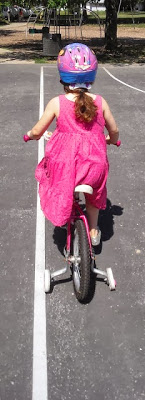
straight-lineA year later she was still learning to ride a bike. I took her to the playground which had a big open basketball court. She talked herself through the process: “Okay, all I have to do is think like a straight line in geometry…” and rode back and forth across the basketball courts chanting her new her mantra.

“Think like a straight line, think like a straight line, think like a straight line in geometry.”

When she’d get to the end of the court, she’d get off the bike and turn it around.  Then she figured she could make the turn without getting off. “All I have to do when I get to the end is think like a circle….”


Perhaps you’ve also noticed your children or students using their bodies to measure, make size comparisons with other objects, or track growth.  Or maybe you’ve noticed them:

  • walking a pathway along the painted lines on a basketball court
  • crossing a tiled floor on the diagonal by stepping on all the corners, or
  • stepping deliberately over every other floor tile in the grocery store

What can we make of this kind of activity?

Children naturally use their bodies as “thinking tools” to explore and make sense of the world. Studies have emphasized the importance of self-produced movement in the development spatial reasoning which is strongly linked to robust mathematical thinking and problem solving. Both spatial thinking and embodied learning — non-verbal, body-based modes of knowing and reasoning — are especially relevant to the development of mathematical intuition and sense making.

You can support the development of sturdy spatial and math skills in children by:

  1. Having conversations. Use spatial and relational words in the context of talking about everyday activities: over, under, around, through, around, above, below, etc.
  2. Pay attention to how children are using their bodies to interact with the environment, especially in new spaces. The more you notice the more you’ll see (and enjoy) their body-based thinking!
  3. Watch their gestures as they talk about math ideas. Many studies have shown, including the one on which this post’s title is based, that gestures paired with speech can show you a lot about a child’s geometric and spatial knowledge for which they may not yet have words.
  4. Play around! During a visit from a VERY tall Uncle Arlen my six-year-old noticed that he was exactly the same length as the couch! They ended up measuring the sunroom in a hilarious series of units called “Arlens.” The room was almost exactly four Arlens long. They also noticed that one “Arlen” was equivalent to two “Isobel’s” and five lengths of our unamused cat Lucy!

Interested in learning more?

This article on the Mind/Shift blog titled Why Kids Need to Move, Touch and Experience to Learn is an excellent overview of embodied learning.

For some succinct and helpful information about spatial reasoning and how to support and develop students’ spatial thinking in the classroom during math time download this free PDF.


Malke Rosenfeld is a dance teaching artist, author, and presenter whose interests focus on the learning that happens at the intersection of math and the moving body. She delights in creating rich environments in which children and adults can explore, make, play, and talk math based on their own questions and inclinations. Her new book is titled: Math on the Move: Engaging Students in Whole Body Learning (Heinemann 2016)


Moving Scale Math on the Hundred Chart

Chapter Three in Math on the Move is titled “Beyond Mnemonics: Getting Starting with Moving-Scale Math.” The chapter is designed as a “zero entry” pool of sorts for whole-body math learning.  You can start at the shallow end and get your feet wet by incorporating students’ whole bodies into familiar math activities you might already be doing at hand or desk scale. Or, if you feel ready, you can jump into the deep end and facilitate a more organized activity.

This chapter is not about replacing an entire math unit with moving-scale, body-based learning or changing your teaching approach overnight. Instead, this is a chance to get a sense of what it feels, looks, and sounds like to engage your students in mathematical sense making by engaging their whole, moving bodies in collaboration with other learners.

The chapter opens with stories from Jenn Kranenburg’s classroom, many of them centered on the large hundred chart she has taped to the floor of her classroom. Today on Twitter she shared a short video of that shows student activity on the “moving scale” hundred chart.  Notice the way this familiar but scaled-up tool opens up whole-class collaboration and conversation, and allows students to fully engage with the spatial nature of the chart.

Updated 10/7, another video from Jenn!

If you’re interested in joining the Facebook discussion group forming around the book please do!  We are learning together and growing a community of practice around meaningful whole-body learning.


Malke Rosenfeld delights in creating rich environments in which children and their adults can explore, make, play, and talk math based on their own questions and inclinations. Her upcoming book, Math on the Move: Engaging Students in Whole Body Learning, will be published by Heinemann in October 2016.

A few thoughts on the difference between memorizing and learning

cropped-img_7144.jpg
Kids making sense of math.

Math on the Move: Engaging Students in Whole Body Learning is organized around three basic ideas:

  1. The body in math learning is best conceived as a thinking tool
  2. Math learning is more than memorization
  3. Amazing learning can happen when the body and math come together in both dance and non-dance settings.

It’s point #2 I’d like to focus on in this post.

A couple years ago Ben Orlin had a fantastic article in the Atlantic titled When Memorization Gets in the Way of Learning. In it, he says:

“What separates memorization from learning is a sense of meaning. When you memorize a fact, it’s arbitrary, interchangeable–it makes no difference to you whether sine of π/2 is one, zero, or a million. But when you learn a fact, it’s bound to others by a web of logic. It could be no other way.”

Most often, the role of the moving body in the classroom, during math time, is that of mnemonic device. Here are some examples of what that might look like:

  • using arms to create symbols for operations, like +, – , and = (focusing on creating representations of the symbols, not expressing their meaning)
  • using hand movements in a song about memorizing a procedure
  • bouncing on an exercise ball while reciting multiplication facts
  • singing a song with an accompanying dance about finding the area of a circle, using movements that bear no relationship to the properties of a circle
  • exploring a math concept such as high versus low in isolation, removed from a narrative context (such as retelling a story) or the larger context of dance learning and making
  • having multiple students become the sides of a triangle by lying on the floor

None of these activities are inherently harmful, some of them may be helpful, and yet, none are at all focused on making sense of mathematical ideas.

In the book I endeavor to explain why we should use the whole, moving body in math learning. I do this by pulling from both research and practice to build a framework for meaningful, body-based math learning. When children harness their innate body knowledge for mathematical sense making, they also harness their whole selves in the pursuit of new ideas and understanding. They develop, communicate, and reason about mathematical ideas both nonverbally and verbally.

Children can make good sense of the world when they get a chance to interact with it, and children are also well able to reason with and about things they observe and do. But they can do this only if they get the chance to do, make, investigate, converse, wonder, build, express, and reflect. Without these kinds of interactions they might still be able to memorize math facts, but memorization would not necessarily mean they would know, for themselves, that something was true.

Ben Orlin said it best:

“Memorization is a frontage road: It runs parallel to the best parts of learning, never intersecting. It’s a detour around all the action, a way of knowing without learning, of answering without understanding.”

I’m SO looking forward to the book being out in another month or so we can grow the practice of meaningful whole-body math learning and teaching together. In the mean time, please feel free to join our book group on Facebook, comprised of educators who want to help their students make sense of math using the original “object to think with” — the whole, moving body.


Malke Rosenfeld delights in creating rich environments in which children and their adults can explore, make, play, and talk math based on their own questions and inclinations. Her upcoming book, Math on the Move: Engaging Students in Whole Body Learning, will be published by Heinemann in October 2016.

TEDx Talk: Jump into math!

My upcoming book reminds us that the body is best positioned as a thinking tool, that math is about more than memorization, and that amazing things can happen when the body and math come together in both dance and non-dance settings.

I gave a TEDx talk in 2013 (before I had even thought to write a book!) which gives a great overview of what Math in Your Feet and whole-body math learning is all about. Math on the Move: Engaging Students in Whole Body Learning will be available in late October and is ready for pre-order.


Malke Rosenfeld delights in creating rich environments in which children and their adults can explore, make, play, and talk math based on their own questions and inclinations. Her upcoming book, Math on the Move: Engaging Students in Whole Body Learning, will be published by Heinemann in Fall 2016.

Math on the Move now ready for pre-order!

cover

“We want math to make sense to our students, and the moving body is a wonderful partner toward that goal.”   —Malke Rosenfeld

Kids love to move. But how do we harness all that kinetic energy effectively for math learning? In Math on the Move, Malke Rosenfeld (creator of Math in Your Feet) shows how pairing math concepts and whole body movement creates opportunities for students to make sense of math in entirely new ways. Malke shares her experience creating dynamic learning environments by:

  • exploring the use of the body as a thinking tool
  • highlighting mathematical ideas that are usefully explored with a moving body
  • providing a range of entry points for learning to facilitate a moving math classroom.

The book is filled with classroom-tested activities and detailed coaching tips, and supported with extensive online video clips.

Read more and/or pre-order by going to the Heinemann site

Join a growing community of practice around whole-body math learning on Facebook!

rb 10a.jpg


Malke Rosenfeld delights in creating rich environments in which children and their adults can explore, make, play, and talk math based on their own questions and inclinations. Her upcoming book, Math on the Move: Engaging Students in Whole Body Learning, will be published by Heinemann in Fall 2016.

What it means when we say “learning through play”

Whole-body math learning should feel playful to the learner. This is a lovely short video about what it means when we say “learning through play.” Instead of building and using the “art machines” shown in this video, children can use their whole bodies as “objects to think with” in similar ways as they work to design, build, explore, and make original and mathematical foot-based dance patterns.


Malke Rosenfeld CroppedMalke Rosenfeld is a percussive dance teaching artist, Heinemann author, editor, math explorer, and presenter whose interests focus on the learning that happens at the intersection of math and the moving body. She delights in creating rich environments in which children and adults can explore, make, play, and talk math based on their own questions and inclinations.You can find out more about her work at malkerosenfeld.com,  on Twitter,  Instagram, or Facebook.